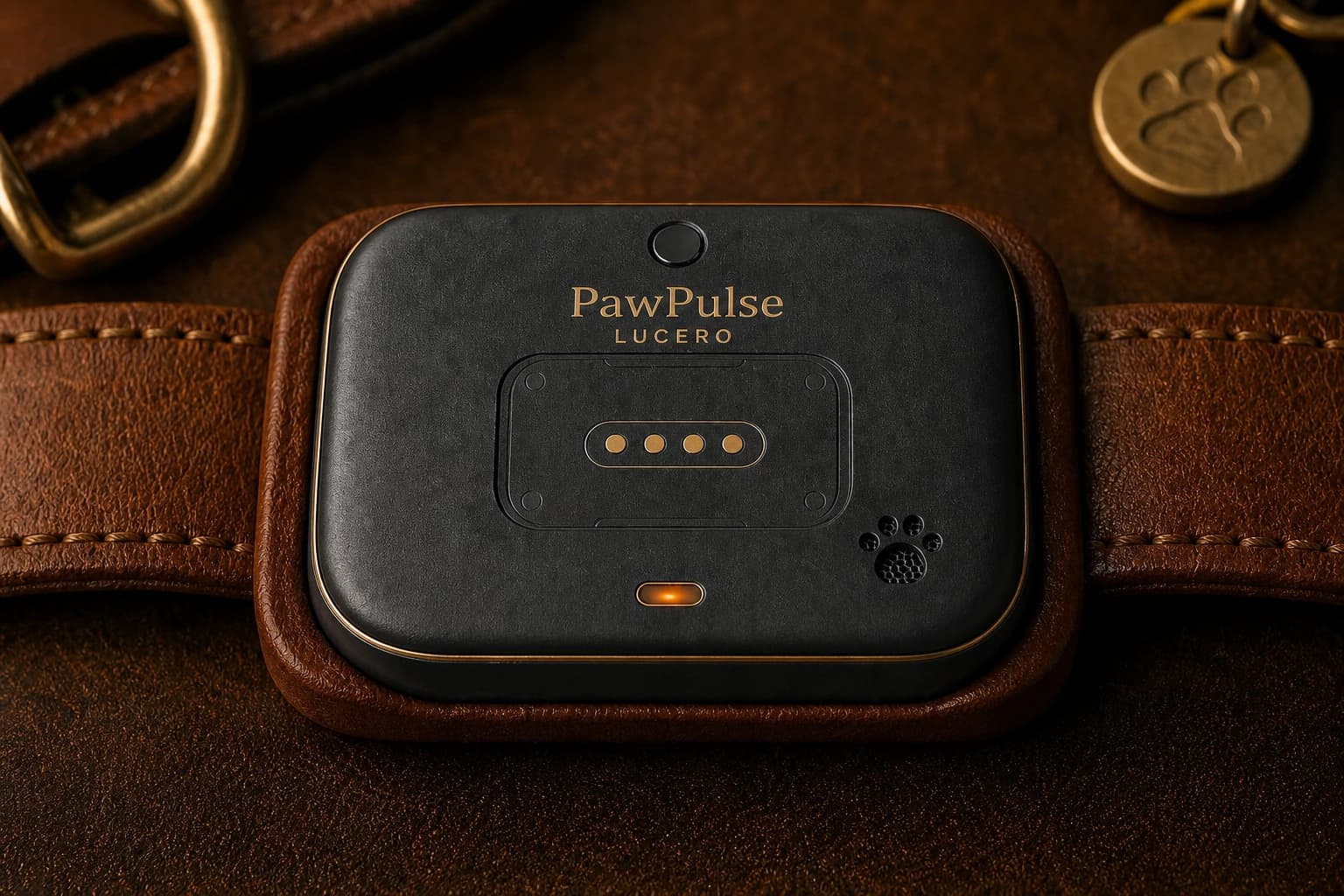
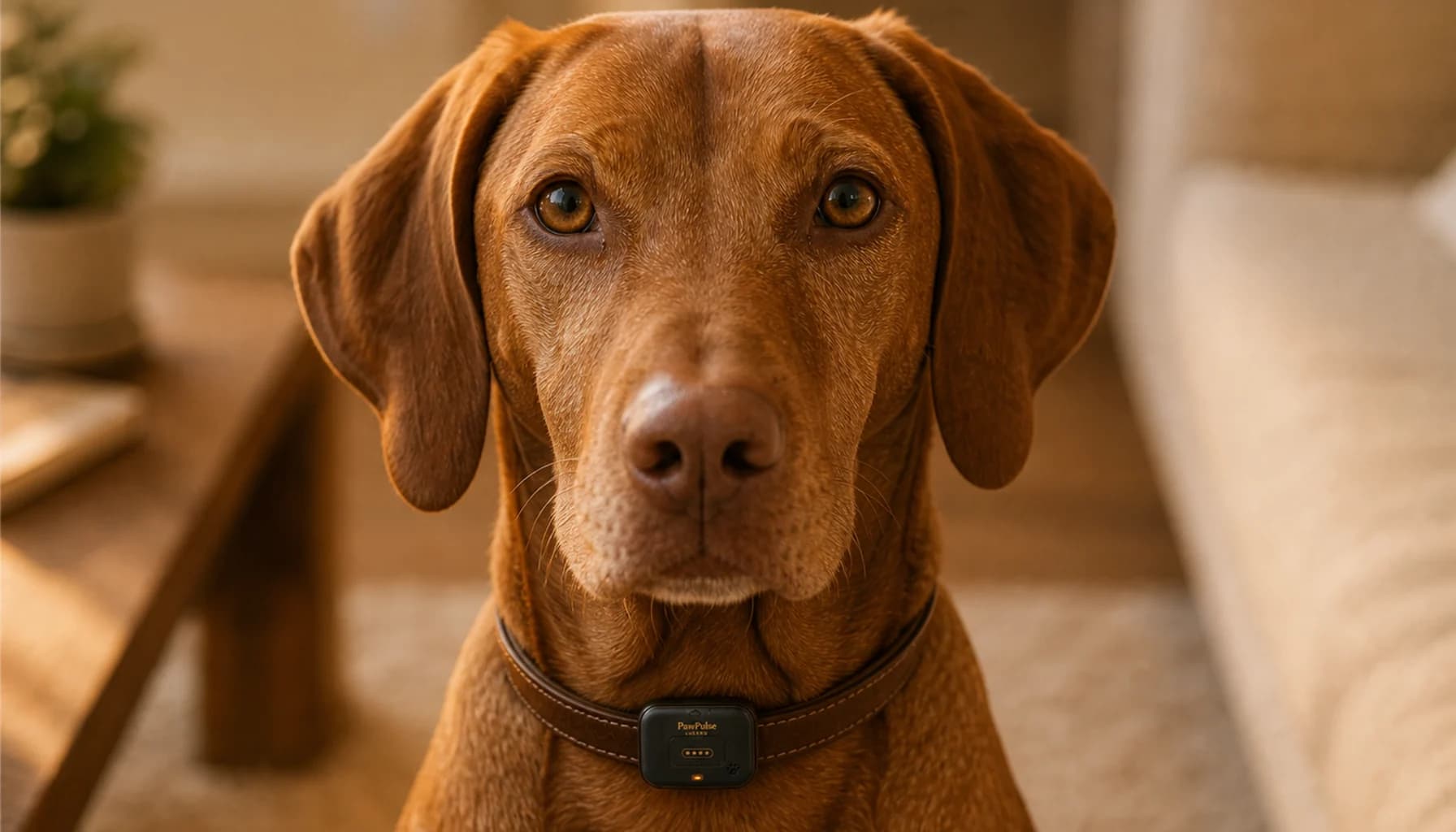
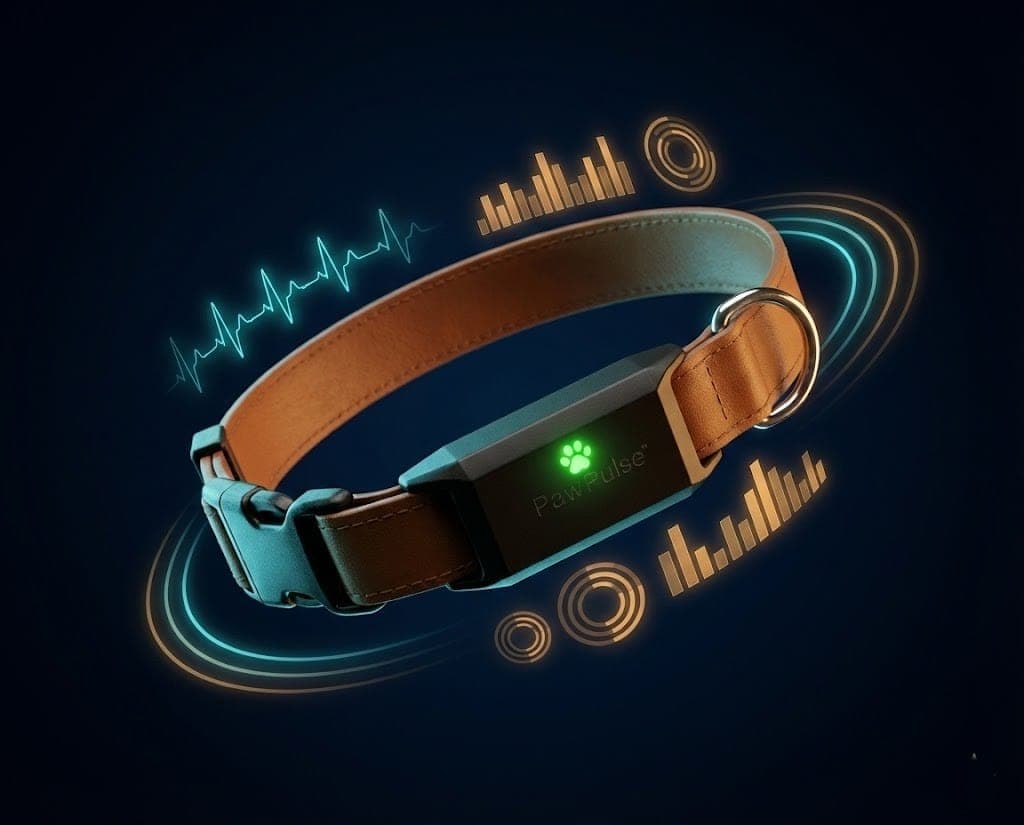
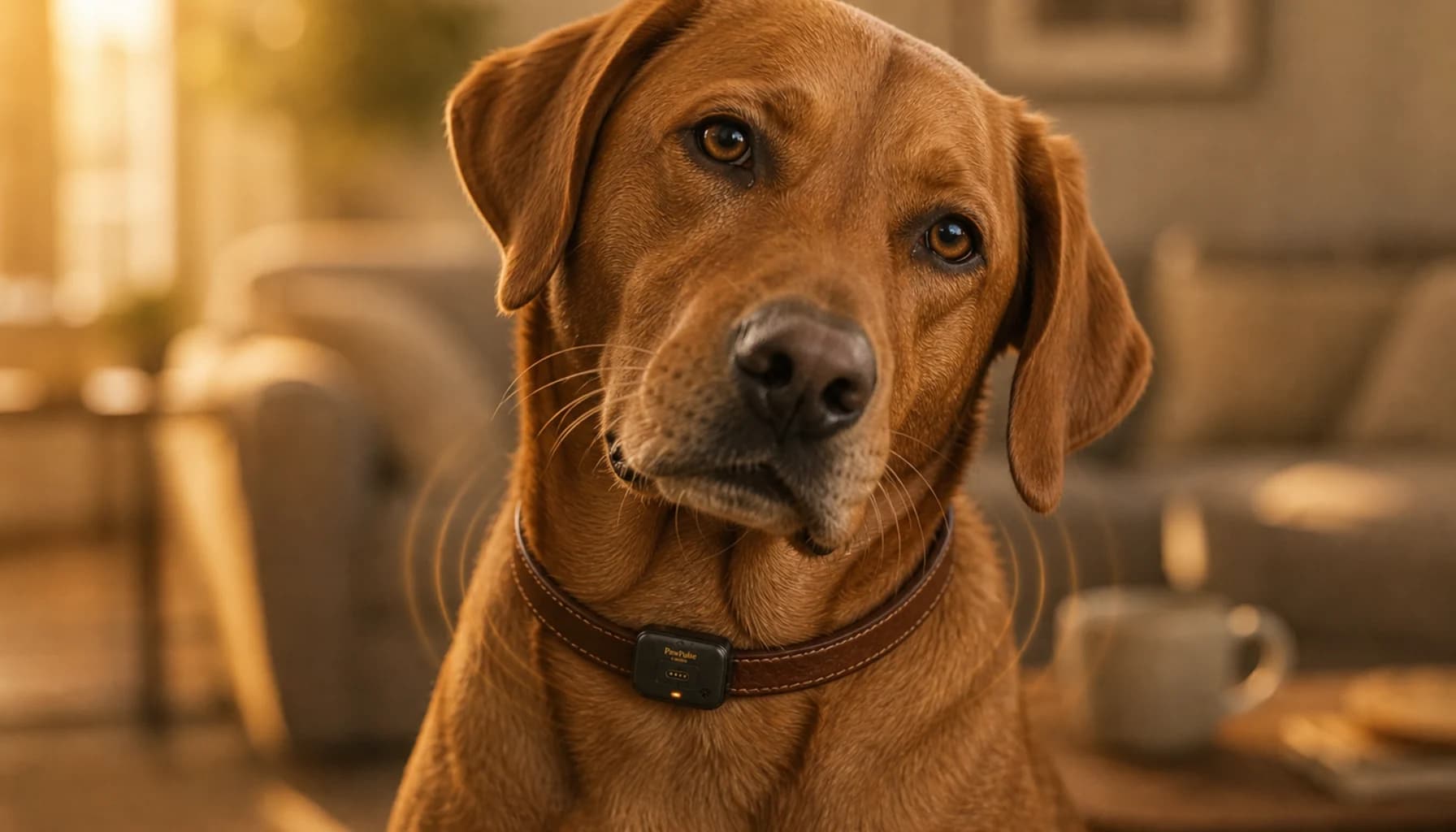
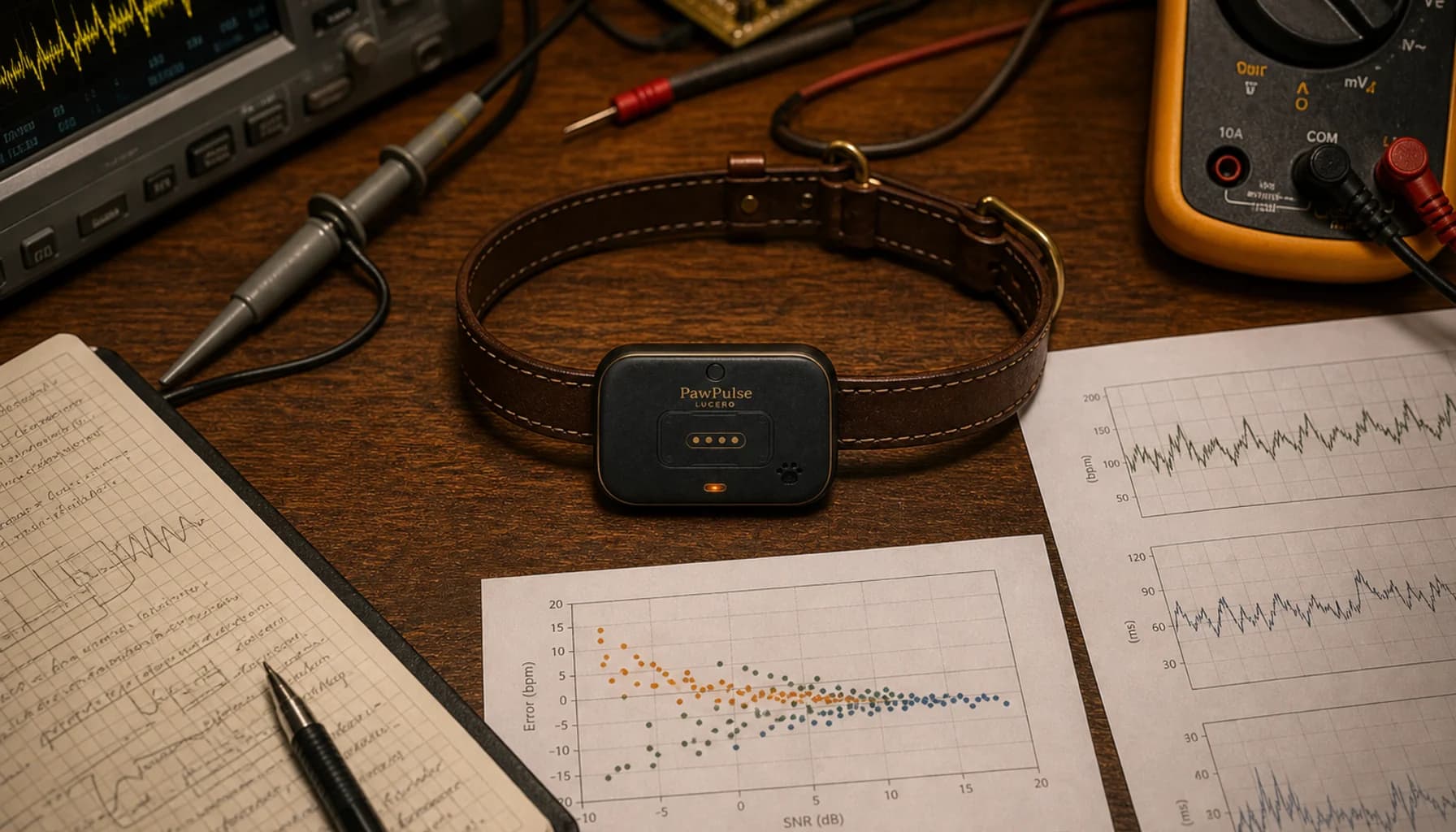
Kinetic sensing picks up heart rate, breathing, and movement on every coat. Prism Insights learns what is normal for your dog and tells you when something changes.
Contactless heart rate and breathing monitoring that works on every coat.
Learns
Prism Insights
Your dog's own normal, starting from 100+ breed profiles.
Locates
GPS + LTE
Live location, with satellite-ready backup past the last bar.
Calms
Pulse Rhythm
Gentle haptic patterns for storms, fireworks, and alone time.
Watch
Lucero in two minutes. See how it works.
The three layers
Signal. Pattern. Context.
Three layers do the work, and they only mean something together. One reads the dog. One learns what is normal for that dog. One reads the world the dog is standing in.
01 / Signal
Radar reads the dog.
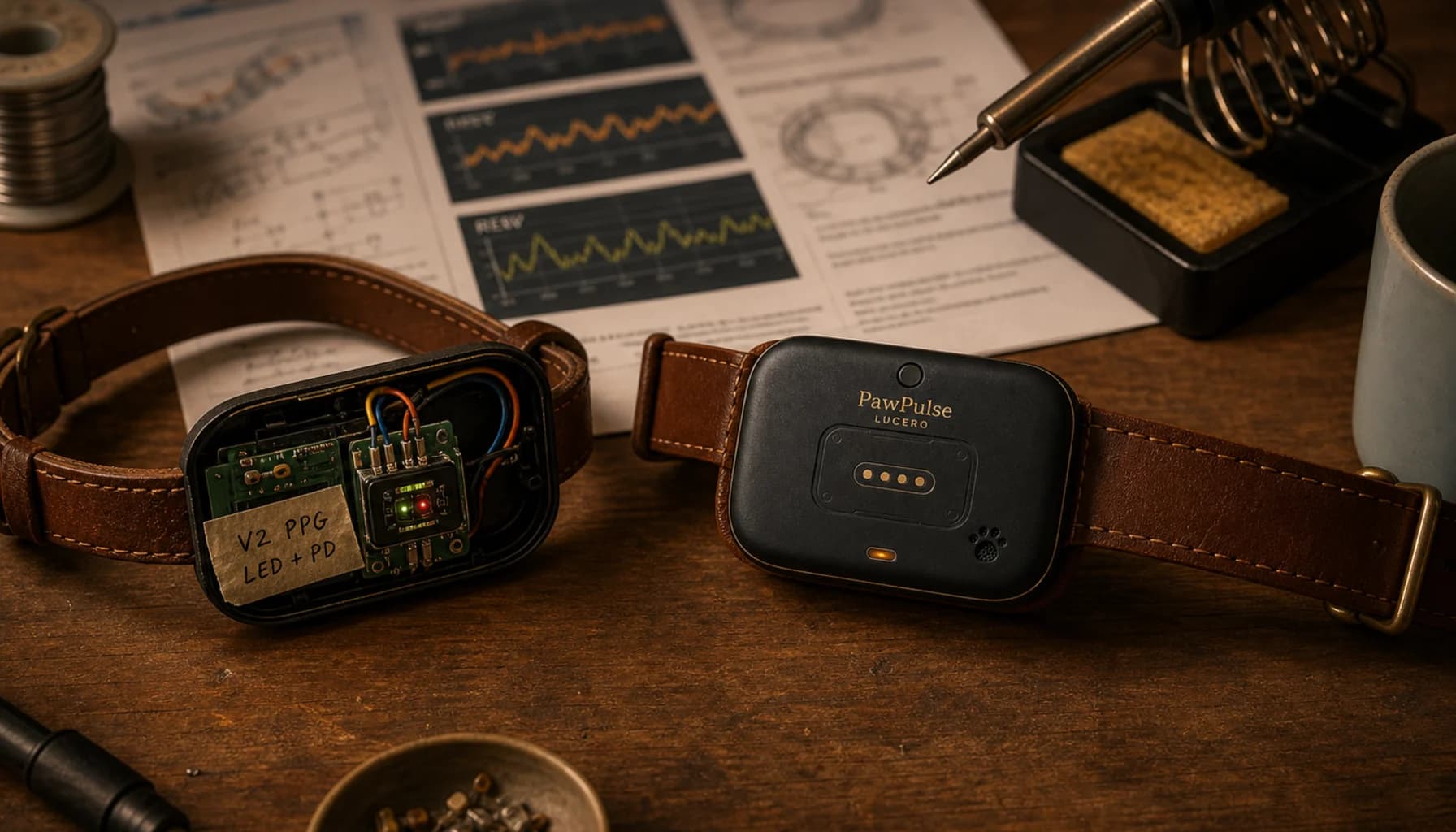
Kinetic is the radar layer. A contactless sensor sits in the collar module and reads straight through the coat: heart rate, heart rate variability, respiratory rate, and the fine chest motion underneath both. Nothing touches skin, nothing gets shaved, and there is no gel or contact patch. That matters because the optical sensors used in human fitness wearables need a clean skin surface to work at all, and on a double-coated husky or a thick-coated retriever they simply stop reading. Radar does not care about coat length. It runs continuously rather than polling on a schedule, so a short irregular stretch does not fall between samples.
+
Day 30+: the comparison is almost entirely your dog
100+
Breed profiles
32+
Signals
Day 1
Baseline from
your dog's normalLast 7 days, read against this dog's own baseline.
02 / Pattern
Prism Insights learns normal.
Prism Insights is the layer that decides what a signal means. On day one it starts from a breed-aware baseline drawn from 100+ breed profiles plus the age and weight you enter at pairing, because a Greyhound resting heart rate is not a Bulldog resting heart rate. Across the first two weeks it shifts toward your dog specifically: their sleep window, their recovery slope after a long walk, their ordinary amount of restlessness. By day thirty the comparison is mostly personal. That is what keeps alerts quiet. A change is worth telling you about when it is a change from your dog, not from an average.
03 / Context
The collar reads the room.
The third layer is everything around the dog. Kinetic adds e-nose and VOC sensing for breath and air chemistry, air-quality awareness for smoke, gas, and allergens, and temperature and humidity taken at the collar itself. GPS with LTE and satellite-ready backup puts all of it on a map. Context is what separates a real health change from a hot afternoon on a porch. Humidity is the largest single factor in canine heat risk, because a panting dog cannot shed heat into saturated air, and Lucero reads the air your dog is actually standing in rather than the nearest weather station.
Kinetic is the PawPulse sensing platform: contactless heart rate and breathing monitoring that works on every coat, running continuously, no shaved patch, no polling. Prism Insights is the breed-aware baseline engine on top of it: every signal Kinetic captures is compared to what is normal for your dog's breed, age, and weight, starting on day one. The two are designed together. Health, location, and calm are processed on the same hardware because the signals are connected in the dog, not separate problems in marketing.
What the stack delivers
Health metrics
32+ monitored continuously
Battery
Long-life design; figures at launch
VOC sensing
Dental, metabolic, and wellness context
Breed profiles
100+ breed-aware baseline models
Location
Lucero GPS + LTE + satellite-ready backup
Pulse Rhythm
Built into Lucero
Vet workflow
Shared history, alerts, and exports
Vet dashboard
Included for partner clinics.
Coat, not skin
Contact sensors need skin. Radar does not.
Optical sensors read by bouncing light off skin, so a coat is a wall. That is why most collars either skip vitals or ask you to shave a patch and keep a puck pressed against it. Drag the divider and look at the same dog two ways.
<>
Contact sensors need skinWorks on every coat
Left. An optical sensor wants a shaved patch and steady skin pressure. Fur scatters the light, the puck slides as the dog moves, and the reading drops out exactly when the dog is doing something interesting.
Right. Radar is contactless. The signal passes through the coat and picks up the small chest movement behind heartbeat and breath. Double coat, wet coat, clipped coat: the trace keeps running, which is why it does not stop at the divider.
The baseline learner
The band around normal keeps getting tighter.
Sense. Radar runs continuously rather than polling on a schedule, so a short irregular stretch does not fall between samples. That is the raw material: resting heart rate, heart rate variability, breathing, and how all three move overnight.
Learn the baseline. Day one starts from a breed-aware band built from 100+ breed profiles plus the age and weight you enter at pairing, because a Greyhound resting heart rate is not a Bulldog resting heart rate. Across the first two weeks Prism Insights pulls that band in toward your dog specifically. By day thirty the comparison is mostly personal.
Notice, then tell you. The same reading can sit quietly inside a wide breed average and clearly outside a narrow personal one. Narrowing the band is the whole job: it is what turns a number into a reason to look up, and it is why a tighter baseline means fewer alerts, not more.
Notified
By day thirty the band is mostly her. The same reading is clearly outside it, and that is the point where telling you is worth doing.
Day 1Quiet
A breed-average band, wide enough to hold most dogs of her breed, age, and weight. This reading sits inside it, so nothing reaches your phone.
Day 14Watching
Two weeks in, the band has pulled toward her own sleep window, her own recovery slope. The same reading is now sitting on the edge of it.
Day 30Notified
By day thirty the band is mostly her. The same reading is clearly outside it, and that is the point where telling you is worth doing.
Example data for illustration, not a reading from a real dog. PawPulse shows you the pattern and the context around it. What it means is a conversation with your vet.
End to end
One night, from first thunder to the vet appointment.
Every layer on this page is doing one job at a time. Here is what it looks like when they do it together, on an ordinary bad night.
9:41 PM
The storm gets there before you do.
Thunder lands somewhere west of the house and Nova is already under the kitchen table. You are still in the car, twenty minutes out, and nobody has told you anything yet.
Storm front over the house
Pressure dropping, thunder close
9:56 PM
She is lying still. Her heart is not.
She has not moved in fifteen minutes, so a step counter would call this rest. The radar is reading through her coat instead, and her resting heart rate has been climbing the whole time she has been lying there.
Resting heart rate climbing
Still, but not settled
10:04 PM
Higher than her, not higher than a chart.
Prism Insights is not holding her against a breed average tonight. It is holding her against the thirty nights before this one, and this one does not look like them. That is the difference between a number and a reason to say something.
Outside her own baseline
22 minutes and holding
10:05 PM
One line. No chart to decode.
Nova has been above her own resting baseline for twenty-two minutes. You start Storm Mode from the app on the driveway, and by the time you are through the door she is out from under the table.
At the clinic you share the window itself: the hours around it, what she was doing, what the collar read. The vet knew what to look at before you sat down, and the appointment was about the pattern instead of about reconstructing it.
Thunder lands somewhere west of the house and Nova is already under the kitchen table. You are still in the car, twenty minutes out, and nobody has told you anything yet.
Storm front over the house
Pressure dropping, thunder close
What is on the collar
Six sensing systems, one module.
Radar is the one that reads your dog. The other five read everything around the reading, which is what keeps it from being a number with no story attached. Hover or tap any one of them to see what it actually watches.
123456
Callout positions are indicative of the module exterior, not an internal layout.
Built on a sensing stack engineered specifically for dogs, not adapted from human wearables.
A health-first platform for GPS, vitals, and calm support.
Lucero runs continuous health monitoring with contactless radar vitals, GPS context, behavior patterns, and calm state processed together.
32+
32+ health signals, running continuously
Heart rate, HRV, respiratory rate, sleep staging, stress index, and VOC context. Not polled. Always on.
100+
100+ breed-specific baselines
Prism Insights does not spend weeks building a picture from scratch. Day one, it knows what normal looks like for your dog's genetics, age, and weight.
1
One smart dog collar, the full stack
Lucero integrates health monitoring, GPS, Pulse Rhythm, and vet sharing at the firmware level.
Security & Quality Standards
Trust starts before the collar ships.
256-bit encryption
Your dog's health data is private. Full stop.
Privacy-first
We do not sell health data. That is not the business model.
Designed in the USA
Hardware and firmware locked before the campaign opens. No post-Kickstarter spec downgrades.
Certification in progress
FCC, ISED, and CE testing underway ahead of Kickstarter.
Built for dogs, not borrowed from wrists
32+ health signals. One view that makes sense of them.
Human wearables were designed for wrists and bare skin. PawPulse was built around how dogs actually breathe, sleep, move, and recover. A handful of signals are sensed directly; the rest are learned from how those signals change over time. You see them together, as one timeline you can actually follow.
10
core signals, sensed continuously
Measured directly by Kinetic sensing, all day and all night, on every coat.
Heart
Heart rate, HRV
Breathing
Respiratory rate, Breath depth
Sleep
Sleep quality, Sleep stage
Movement
Activity, Posture shifts
Stress and breath
Stress, Breath VOC
Plus the context around them
Air qualityTemperature and humidityVocalization patternsLocation
22+
derived signals, learned over time
Calculated from how the core signals move across hours, nights, and weeks. This is where most of the value lives: a single reading says little, a two-week trend says a lot.
Resting heart rate trendOvernight breathing baselineRecovery after exerciseResting driftSleep consistencyAnomaly countsActivity rhythmBreed-adjusted indicesand more
Resting heart rate, 14 nightsExample
Each night looked fine on its own. The trend is what gets noticed.
Radar vitals
See cardiac signals that location-only collars never touch.
PawPulse keeps cardiac data visible from the first wear session, not just after a long learning window. That means heart rate, HRV, recovery drift, and anomaly context live in the same view.
Kinetic sensing works on every coat, with no shaving and no skin sensor.
HRV and recovery context add signal beyond raw pulse count alone.
Owners and vets see the same live thread instead of screenshots and guesswork.
vs ordinary collars
Most collars stop at steps and map pins. PawPulse adds a live cardiac layer owners can actually act on.
Cardiac + HRV
Example
Heart rate72 bpm
HRV41 ms
Recovery score87%
Anomaly watchLow
Heart rateHRVRecoveryResting drift
32+
Health signals
One living stream of vitals, behavior, and environment.
100+
Breed profiles
Prism starts breed-aware before it learns your dog.
Protected
Patent-pending technology
Focused on sensing, signal intelligence, and daily-wear design.
From signal to action
How the app turns signals into something you can act on.
Raw telemetry is not useful to anyone at seven in the morning. The job of the app is to turn 32+ continuously derived signals into the four questions an owner actually asks: is my dog okay, where is my dog, can I help them settle, and what do I tell the vet. Each screen answers one of them, and none of them ask you to decode a chart to find out whether something matters. The one-tap summary hands your vet the trend history a short appointment never leaves room for. See how the calming side works or what clinics see.
The app
What you see on your phone
Four core screens. Each one answers a question you would otherwise call your vet about.
Health timeline
Respiration, heart rhythm, and activity plotted across days and weeks. Tap any point to see what was happening.
Live location
GPS position updated on a map with battery and signal strength. Satellite-ready backup shows coverage status.
Pulse Rhythm controls
Start, schedule, or automate calming sessions. See which patterns your dog responds to over time.
Vet share
One tap generates a summary your vet can read without installing anything. Health trends, alerts, and notes in one link.
In your hand
See it in the app.
Everything the collar reads lands in one timeline you can scroll, not a wall of raw numbers. Tap a spike and the app shows you what your dog was doing when it happened.
Six chapters, from where your dog is to how they are breathing. Jump to the one you care about.
01GPS and Connectivity
How Accurate Is PawPulse GPS Tracking?
Track your dog's location with multi-constellation GNSS and a connectivity plan designed for LTE plus NTN satellite-ready backup when ordinary coverage gets unreliable.
Final satellite availability depends on carrier support, launch configuration, and regional certification. Coverage detail gets published as those land.
Live Location Updates
Live position on the map, with a faster refresh while you are actively tracking.
Smart Safe Zones
AI suggests zones based on your dog's habits. Get instant alerts when they enter or exit boundaries.
Location History
View routes, favorite spots, and daily patterns. Share secure location links with family or dog walkers.
02NTN Satellite Technology
Find Your Dog Past the Last Bar of Signal
Cellular coverage can get unreliable fast on trails, farms, rural roads, and open land. Lucero is designed with LTE plus NTN satellite-ready backup so the location plan does not depend on one network path.
Perfect for Hikers and Adventurers
Take your dog on backcountry trails with a collar designed to fall back to satellite when cellular coverage drops.
Built for Farm and Ranch Life
Working dogs roam hundreds of acres. Rural properties often have spotty cell coverage, so Lucero pairs LTE with satellite-ready backup.
Hunting and Sporting Dogs
Bird dogs, hounds, and retrievers often work miles from the truck in weak-signal areas. NTN backup is designed to add another path when cellular is unavailable.
LTE plus satellite-ready backup
LEO NTN rollout depends on final launch configuration, carrier support, and certification. Built for trails, farms, wilderness, and parks.
03Kinetic Sensor Platform
How Does PawPulse Monitor Heart Rate on Every Coat?
Contactless heart rate and breathing monitoring uses Kinetic sensing, with no shaving and no contact patches. Prism Insights helps surface unusual patterns early.
Works on Every Coat
Kinetic sensing works on every coat, thick double coats included. No shaving or contact patches needed, and it works across breeds.
Change Alerts
Prism Insights watches for unusual heart-rate and recovery patterns so owners can see changes sooner.
Breed-Specific Baselines
Greyhounds have different normal ranges than Chihuahuas. Prism Insights starts breed-aware, then learns your dog's own baseline.
04Kinetic Sensor Platform
How Does PawPulse Read Heat Risk?
Kinetic sensing brings environmental context into the PawPulse health picture. Prism Insights combines air quality, heat, humidity, and activity signals to help surface risk earlier.
Humidity Detection
Onboard environmental sensors track humidity, a major factor in canine heat stress. Dogs can't sweat; when humidity is high, panting doesn't cool them.
Heat Index Analysis
Prism Insights combines air temperature, humidity, and your dog's activity level into a real-time heat-risk picture. Get alerts as conditions build, not after.
Early Heat Warnings
"Risk Level: HIGH" alerts nudge you to find shade or water while conditions are building, not after your dog is already struggling. Context first, so you can act early.
05Prism Insights
What Is Prism Insights and How Does It Work?
Prism Insights starts with breed-aware baselines, then learns your dog's daily patterns so alerts become more personal over time.
Personalized Baselines
Learns what's "normal" for your specific dog across the first two weeks. Adapts to age, breed, and activity patterns.
On-Device Processing
Core sensing keeps recording on the collar without a cell signal and syncs to the app when it reconnects.
Pattern Insights
Pattern recognition surfaces subtle shifts away from your dog's normal, the kind owners often only notice in hindsight.
06Pulse Rhythm Technology
Built-In Pulse Rhythm for Anxious Moments
Pressure wraps are passive. PawPulse features built-in Pulse Rhythm: research-informed haptic patterns designed to help calm anxious dogs, triggered from the app when the collar is connected.
Mode 1
Deep Calm
55 Hz continuous
Gentle, sustained calming vibration
Mode 2
Heartbeat Mode
60 BPM rhythm
For time apart
Mode 3
Storm Mode
Variable pattern
For thunderstorms and fireworks
Research-Informed Haptics
Gentle 55 Hz patterns, tuned for calming support. Pulse Rhythm is calming support, not a treatment.
Three Calming Modes
Deep Calm (55 Hz calming), Heartbeat Mode (60 BPM rhythm for time apart), and Storm Mode (variable pattern for thunderstorms and fireworks).
14-Day Conditioning Program
A built-in conditioning program teaches your dog to associate the gentle vibration with safety and comfort. By Day 14, automatic calming support can activate when signs of stress are detected.
Built into Lucero
Calming support you can trigger from the app when the collar is connected. No separate device to buy.
Technology questions
How the stack actually works
Specifics on the sensing, the baselines, the radios, and what happens when the network or your phone is not there.
Sensing
Optical sensors work by bouncing light off skin, so they need a clean, shaved contact patch. Fur scatters that light, which is why most collars either skip vitals entirely or ask you to shave a spot. Lucero uses Kinetic sensing instead: contactless heart rate and breathing monitoring that picks up the small chest movements behind heartbeat and breath. It works on every coat length, with no gel, no shaving, and no contact patches.
Sensing
Ten are core vitals: heart rate, HRV, respiratory rate, sleep quality, sleep stage, stress, posture shifts, activity, breath depth, and breath VOC. The other twenty-two or more are derived from those: trend lines, anomaly counters, recovery context, and breed-adjusted indices calculated over time. The derived layer carries most of the value, because a single reading tells you far less than how that reading has been moving for the last two weeks.
Prism Insights
On day one, Prism Insights compares your dog against a breed-aware model built from 100+ breed profiles plus the age and weight you enter at pairing, so there is a sensible reference from the first wear session. By day fourteen it has learned your dog specifically: sleep window, activity rhythm, recovery slope. By day thirty and beyond the comparison is mostly personal, which is what keeps alerts pointed and quiet.
Sensing
The e-nose reads volatile organic compounds in your dog's breath and in the surrounding air. On the air side that means smoke, gas, and allergen context, paired with temperature and humidity measured at the collar. On the breath side it adds dental, metabolic, and wellness context to the wider health picture. It is context rather than a verdict: it helps explain why something changed instead of declaring what is wrong.
Location
Position comes from multi-band GPS and GLONASS, typically accurate to 5-10 feet outdoors. That position travels over LTE-M or NB-IoT wherever cellular reaches. Where it does not, Lucero is engineered with NTN low-earth-orbit satellite-ready backup as a second path. Final satellite availability depends on carrier support, launch configuration, certification, and regional rollout, so treat it as a designed-in fallback rather than a guaranteed link everywhere.
Pulse Rhythm
Pulse Rhythm is built-in haptic calming support. Three modes cover different stress contexts: Deep Calm at a steady 55 Hz, Heartbeat Mode at a 60 BPM rhythm for time apart, and Storm Mode for acute events like fireworks. You trigger it from the app. It is not a drug, not a cure, and not a substitute for professional veterinary care.
Privacy
Vet sharing is owner-approved. A clinic sees trends, alerts, and reports only when you grant access, and the one-tap summary is a link you generate for the vet you choose. Nothing routes to a clinic automatically. PawPulse Care, the clinic-side dashboard, is in active development, and owner approval stays the gate on every view a clinic gets.
Durability
Yes. Lucero carries an IP67 rating: fully sealed against dust and protected against immersion in up to 1 meter of water for 30 minutes. Rain, mud, splashes, and brief dips are ordinary wear; it is not built for continuous deep-water use. A wet coat does not stop Kinetic sensing the way it can an optical sensor, so vitals keep reading while your dog dries off.
Software
Over the air and automatically, by cellular or Bluetooth. There is no cable and no manual step. That matters because much of the sensing stack is software: baseline models, anomaly scoring, and Pulse Rhythm patterns all keep improving after the collar ships, and those improvements land on hardware you already own instead of waiting for a next-generation product.
Connectivity
Lucero does not depend on your phone being nearby. With its cellular connection active, location and health signals keep flowing while you are at work, asleep, or out of the house, and the app fills in the timeline when you open it again. Bluetooth is there for pairing and fast local sync, not for the collar to do its job.